Skip to content
Chip Mounting vs. Printing: Which Is Better for Paint Color Chart Production?
Choosing the right production method is one of the most important decisions when creating a professional paint colour catalogue. Although both printing and chip mounting can be used in color chart production, the final results are significantly different in terms of colour accuracy, surface quality, durability and customer experience.
At Anora Trading, we produce customised paint catalogues, fan decks, shade cards and colour cards for international paint manufacturers and paint brands. You can explore our different catalogue models and recent projects here:
View Our Paint Catalogue Models
For paint brands that need accurate colour presentation, chip mounting is generally a much more reliable and professional solution than conventional printing.
What Is a Printed Paint Colour Chart?
In a printed paint chart, the colours are reproduced directly on paper using a standard printing process, usually based on the CMYK colour system or specially prepared printing inks.
Printed charts may be suitable for promotional brochures, product leaflets and low-cost marketing materials. However, they have a major disadvantage: printing inks cannot accurately reproduce every real paint colour.
Architectural and decorative paints have their own pigments, opacity levels, textures and light-reflection characteristics. When a real paint colour is converted into CMYK and printed on paper, some of these properties can be lost.
Consequently, the colour seen in the catalogue may differ from the actual colour applied to a wall. This can create incorrect customer expectations, product selection problems and potential complaints.
Why Is Printing Disadvantageous for Paint Manufacturers?
A computer screen, a printing machine and real architectural paint use different methods to display colour. A shade that appears correct in a digital design may change when it is transferred to printed paper.
The main disadvantages of printed paint charts include:
- Limited reproduction of deep, bright and saturated colours
- Differences between printed samples and actual wall paint
- Loss of the original paint’s gloss, texture and surface appearance
- Possible colour variations between separate printing batches
- Different appearances under daylight, warm lighting and LED lighting
- Lower customer confidence when selecting an exact paint shade
Printing can provide an approximate colour reference, but it is not always suitable for professional color chart production, especially when the catalogue will be used for final colour selection.
What Is Chip Mounting in Paint Catalogue Production?
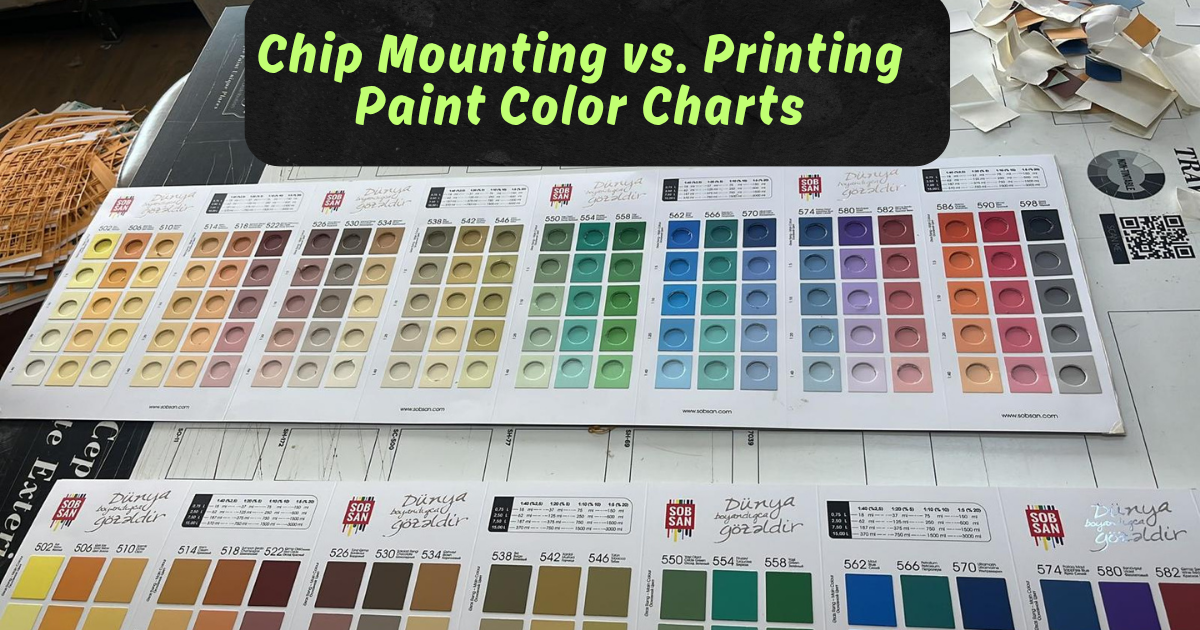
In the chip mounting method, individual colour chips are produced separately and then mounted onto the pages of a paint catalogue, shade card or fan deck.
These chips can be coated using real paint or a specially formulated coating that is accurately matched to the paint manufacturer’s approved colour standards. This allows the mounted chip to represent the depth, finish and visual appearance of the actual paint colour more successfully than printing.
Chip mounting is particularly valuable for paint manufacturers offering large collections of interior paints, exterior paints, decorative coatings or industrial finishes.
Advantages of Chip-Mounted Paint Colour Charts
The most important benefit of chip mounting is superior colour accuracy. Since every shade is prepared and controlled individually, the final catalogue provides a much more realistic colour reference.
The main advantages include:
- More accurate representation of real paint colours
- Better consistency throughout the production order
- Individual quality control for every colour
- Premium and professional catalogue presentation
- Possibility of representing matte, satin or glossy finishes
- Improved confidence for customers, dealers, architects and designers
- Stronger brand image at retail stores and dealer locations
A professionally produced chip-mounted fan deck can be used for several years as an important sales and marketing tool. It helps customers compare shades, understand colour families and select the most appropriate paint colour for their projects.
How Does Anora Trading Manage Color Chart Production?
At Anora Trading, we provide a complete, turnkey color chart production service for international paint brands. Our process can begin with the customer’s existing colour chart, wet paint samples, painted panels or selected colour references.
First, the requested colours are analysed and matched according to the project requirements. We then prepare sample colour chips for the customer’s evaluation. These samples can be checked, revised when necessary and submitted for final approval.
After colour approval, we continue with:
- Catalogue size and model selection
- Colour matching and sample-chip preparation
- Customer approval of the colours
- Graphic design and page layout
- Production of individual colour chips
- Automatic or manual chip mounting
- Printing, cutting and catalogue assembly
- Final quality control, packaging and shipment
We can produce different models, including fan decks, foldable colour cards, wall paint catalogues, shade cards and customised colour presentation tools.
Chip Mounting or Printing: Which Should You Choose?
Printing may be an economical option for temporary brochures or materials where colours are shown only as general references. However, when customers use a catalogue to choose an exact paint shade, chip mounting is the safer and more professional method.
For international paint manufacturers that value colour accuracy, consistency, brand reputation and long-term catalogue quality, chip-mounted paint colour charts provide a clear advantage.
At Anora Trading, we help paint brands develop customised and reliable catalogue solutions from colour matching and sample preparation to design, production and international shipment.
Explore Our Paint Catalogue Projects on YouTube
Visit the Anora Trading YouTube channel to watch our paint catalogue production videos, completed fan deck projects, colour chart examples and sourcing content from Turkey: